
Not a Vision Problem: Why Carriers Stalled on Innovation, and How AI Lifts the Coasean Ceiling

Executive summary
Last week I looked at how AI changes the economics of insurance distribution. This piece looks inside the carrier: why good ideas stalled, and what changes now.
Insurance carriers have not lacked vision over the last decade. They have lacked time and resources. Most carriers still spend the majority of their IT budgets keeping old systems running, and most of their innovation never makes it out of the pilot stage.
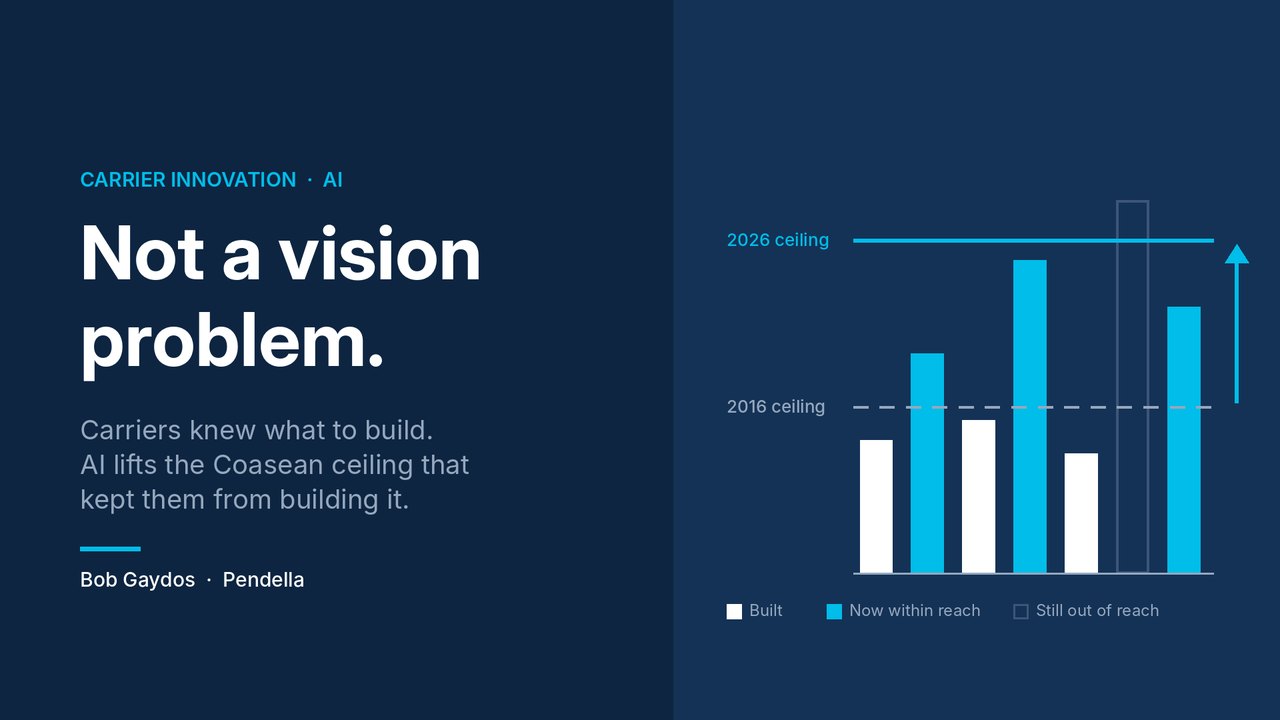
In economic terms, carriers hit a Coasean ceiling: the cost of coordinating change inside a large, complex organization rose faster than the value of each new initiative. Good ideas died not because they were wrong, but because they were too expensive to organize.
AI changes that math. It lowers the cost of coordination inside the carrier and across its partners. The ceiling does not disappear, but it rises. Initiatives that were too expensive to run in 2016 become affordable in 2026. The carriers that move first will be the ones that treat AI as a way to amplify their people, not only to reduce them.
A decade of good ideas, stalled
Carriers saw the future early. Instant underwriting, embedded distribution, digital self-service, data-driven pricing and AI were all on carrier strategy decks years ago. The ideas were right. The execution capacity was not there.
The numbers show where the time and money went:
| Constraint | Evidence |
|---|---|
| Run costs crowd out change | In a survey of 100 US insurance executives, 93% spend most of their IT budget on running existing systems; only 7% spend more on change than on maintenance (Wipro) |
| Projects get cut | In a separate survey of 300 US insurance executives, 52% delayed or canceled two to three strategic technology projects in the past year because of budget (West Monroe) |
| Modernization runs for years | Two-thirds of insurers expect three to seven more years just to move core systems to the cloud; 14% have no timeline (West Monroe, in Insurance Thought Leadership) |
| Pilots do not scale | Only 7% of insurers surveyed have brought AI to scale, even though insurance leads most industries in AI adoption (BCG) |
Swipe the table sideways to see every column.
None of this describes a lack of imagination. It describes an industry that knew what to build but could not free the people, budget and calendar to build it.
The real constraint, in Coase's terms
Ronald Coase explained in 1937 that firms exist because markets are costly to use, and that a firm grows until organizing one more activity inside costs as much as buying it outside. Clay Shirky later named the upper limit the Coasean ceiling: the size above which managing an institution costs so much that it stops working well.
A large carrier sits close to that ceiling. Every new initiative has to pass through actuarial, underwriting, compliance, legal, IT, distribution and finance. It has to connect to a policy system built decades ago and to partners that each need their own contract and integration. Each handoff is a transaction cost.
That is why innovation stalled. A digital product that would produce real value still had to absorb months of meetings, specifications, testing and approvals. When the coordination cost of a project exceeded its expected return, the rational choice was to delay it, shrink it to a pilot, or cancel it. Carriers made that choice over and over, and they were not wrong to.
The ceiling also explains why so much carrier innovation moved outside the firm, into insurtechs, MGAs and partnerships. When organizing a capability internally costs too much, Coase predicts you buy it from the market instead.
What AI changes: lifting the ceiling, not breaking it
AI does not abolish the Coasean ceiling. It raises it. Coase noted that a technology like the telephone cuts both the cost of organizing inside a firm and the cost of using the market; which falls faster decides whether firms grow or shrink. AI is lowering both, quickly. The theory holds; the math changes.
For a carrier, the math changes in three places:
- Time. Work that took a team weeks, such as writing specs, mapping data, drafting filings, building test cases and summarizing results, now takes days or hours. A project's calendar cost drops, so more projects clear the bar.
- Resources. The same team can do more. A small group with AI tools can run an initiative that once needed a large program office. That frees money and people even while legacy run costs remain.
- Coordination. Agents and shared data reduce the handoffs between departments and partners. Each new channel, carrier partner or data source costs less to connect.
When all three costs fall at once, the ceiling rises. A carrier can take on more change without collapsing under its own complexity.
What carriers can do now that they could not in 2016
| Initiative | Why it stalled before | Why it is within reach now |
|---|---|---|
| Instant underwriting | Rules engines and data integrations took years and large teams to build and tune | AI speeds data mapping, model building and testing; decisions can happen in minutes at the point of sale |
| Embedded distribution | Each platform partner needed custom integration, contracts and servicing | Standard APIs plus agents make each new channel, such as an employer benefits platform, cheaper to add |
| Small-premium products | Acquisition and underwriting costs exceeded the lifetime value of a small policy | Lower cost per sale and per decision makes a modest monthly premium profitable |
| Personal recommendations | Advice required a licensed person for every conversation | AI benefit advisors size the need and narrow the choice; humans handle complex cases |
| Legacy modernization | Rewriting decades of code and business rules was slow and risky | AI helps document, translate and test old code, shortening the path off legacy cores |
| Scaling pilots | Each pilot needed its own team to move into production and maintain | Smaller teams can own, monitor and run more systems in production |
Swipe the table sideways to see every column.
The common thread: the vision on carrier strategy decks from 2016 is still right. What changed is the cost of getting there.
People stay central
Labor and capital have always been complements. When a tool makes a person more productive, that person's work is worth more. Carriers that use AI only to cut headcount will save money and miss the bigger prize. Carriers that use it to amplify their people are better placed to grow.
The human role also changes rather than disappears. A routine term policy during open enrollment should be fast and automated. A claim after a death, or a complex estate or business case, needs human judgment and empathy.
The design rule for carriers: automate the transaction, keep the trust. Let AI carry the paperwork, data and routine decisions. Put underwriters, advisors and claims professionals where the stakes are high.
A playbook for carrier leaders
- Reopen the shelved list. Pull out the initiatives you delayed or canceled for cost or time in the last five years. Re-price each one assuming AI-assisted teams. Many will now clear the bar.
- Fund change, not just run. Use AI to cut the cost of maintaining legacy systems first, then move the savings into new products and channels.
- Scale fewer pilots, faster. Pick two or three domains, such as underwriting, distribution and service, and take them to production with a named owner and a clear measure of success.
- Buy coordination from the market. Where an outside partner can connect channels, data and products faster, plug in rather than rebuild. A lifted ceiling makes partnerships cheaper to manage, too.
- Go where customers already are. Embedded distribution through employer benefits and other trusted platforms is now affordable to run at scale.
- Invest in your people. Train underwriters, product teams and distribution staff to work with AI. Their productivity is where the return shows up.
Conclusion
There is no such thing as unlimited time and unlimited resources. For a decade, that limit, not a lack of vision, decided which carrier ideas lived and which died. AI does not remove the limit, but it moves it. Time moves faster, resources go farther, and the Coasean ceiling rises.
The carriers that recognize this will revisit the ideas they already had and finally build them. Those that wait will find that partners, distributors and customers have moved to carriers that did.
Sources
- Ronald Coase, "The Nature of the Firm," Economica (1937); summarized in Revisiting Coase's Theory of the Firm in the Age of AI Agents, HackerNoon
- Clay Shirky, Here Comes Everybody (2008); IEEE Spectrum review
- Wipro, From Run to Reinvention: How Insurers Are Reshaping IT Spend
- West Monroe, Insurance AI Readiness, Jun 2026 (survey of 300 US insurance executives)
- Peter McMurtrie (West Monroe), Insurance Modernization Is Stalling, Insurance Thought Leadership, Dec 2025
- BCG, Insurance Leads in AI Adoption. Now It's Time to Scale., Sep 2025